Methodology and Reproducibility of Nonperfusion Area on UWF-FA
 Mary Wilda, Rachel Halweg, Cynthia Hurtenbach, Kristi Dohm, Justin Parks, Ruth Shaw, Sheila Watson, Kari Moseman, Rick Voland, Barbara A. Blodi
Abstract
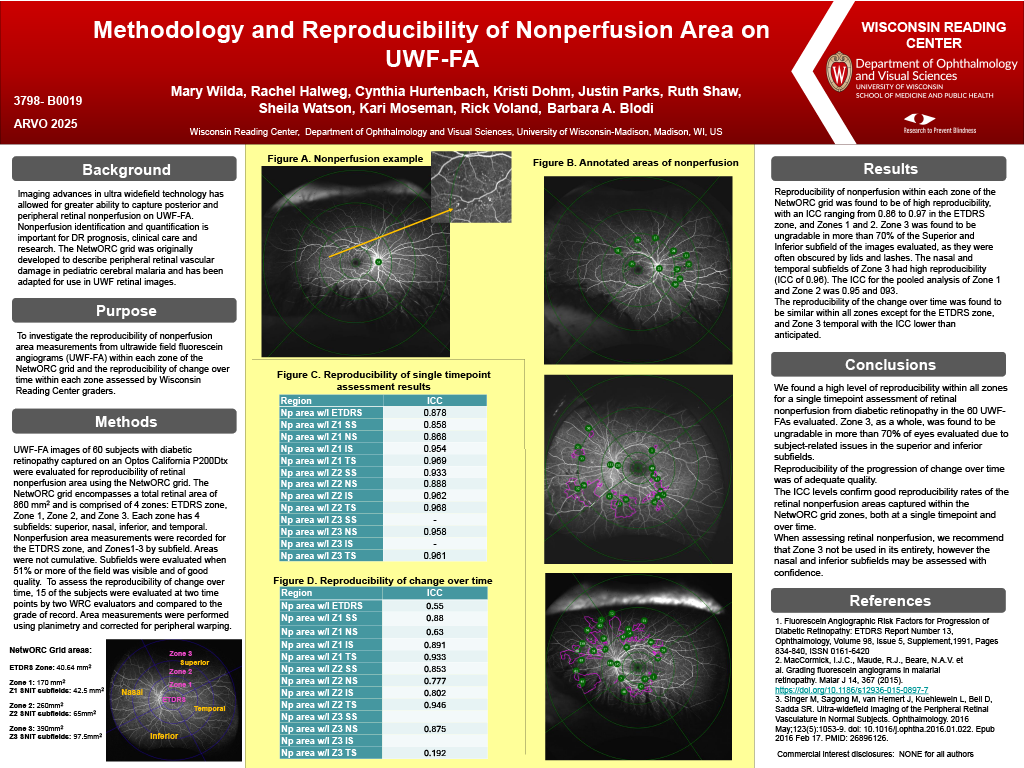
Purpose: To investigate the reproducibility of nonperfusion area measurements from ultrawide field fluorescein angiograms (UWF-FA) within each zone of the NetwORC grid and the reproducibility of change over time within each zone assessed by Wisconsin Reading Center graders.
Methods: UWF-FA images of 45 subjects captured on an Optos California P200Dtx were evaluated for reproducibility of retinal nonperfusion area using the NetwORC grid. The NetwORC grid comprises 4 zones: ETDRS zone, Zone 1, Zone 2, and Zone 3 with 4 subfields in each zone encompassing a total area of 860 mm2. Nonperfusion area measurements were recorded for the specific zone and subfield listed and were not cumulative. Subfields were evaluated when 51% or more of the field was visible and of good quality. In 15 of the subjects two time points were regraded by two WRC evaluators and compared to the grade of record. Area measurements were performed using planimetry and corrected for peripheral warping.
Results: Reproducibility of nonperfusion within each zone was found to be of high quality, with an ICC ranging from 0.69 to 0.97 in the ETDRS zone, and Zones 1 and 2. Zone 3 was found to be ungradable in 68% of the images evaluated, as the superior and inferior subfield were often obscured by lids and lashes. The nasal and temporal subfields of Zone 3 had high reproducibility (ICC of 0.92 and 0.84). The reproducibility of the change over time was found to be similar within all zones except for the ETDRS zone, with the ICC lower than anticipated due to two areas of high disagreement.
Conclusions: We found that retinal nonperfusion from UWF-FAs had a high level of reproducibility within the ETDRS, Zone 1, and Zone 2. Zone 3 was found to be ungradable in more than half of the eyes due to subject-related issues in the Superior and Inferior subfields. Reproducibility of the progression of change over time was of adequate quality. The ICC levels confirm the reproducibility and quality of the retinal nonperfusion areas captured within the NetwORC grid zones. In assessing retinal nonperfusion, we recommend that Zone 3 not be used in its entirety, but the Nasal and Inferior subfields may be assessed with confidence.