Predicting Geographic Atrophy Risk Using Autofluorescence Imaging and Artificial Intelligence
 Robert D. Slater, Apoorva Safai, Madeline Pflasterer-Jennerjohn, Jennifer Heathcote, Rachel E. Linderman, Pallavi Tiwari, Emily Chew, Amitha Domalpally
Abstract
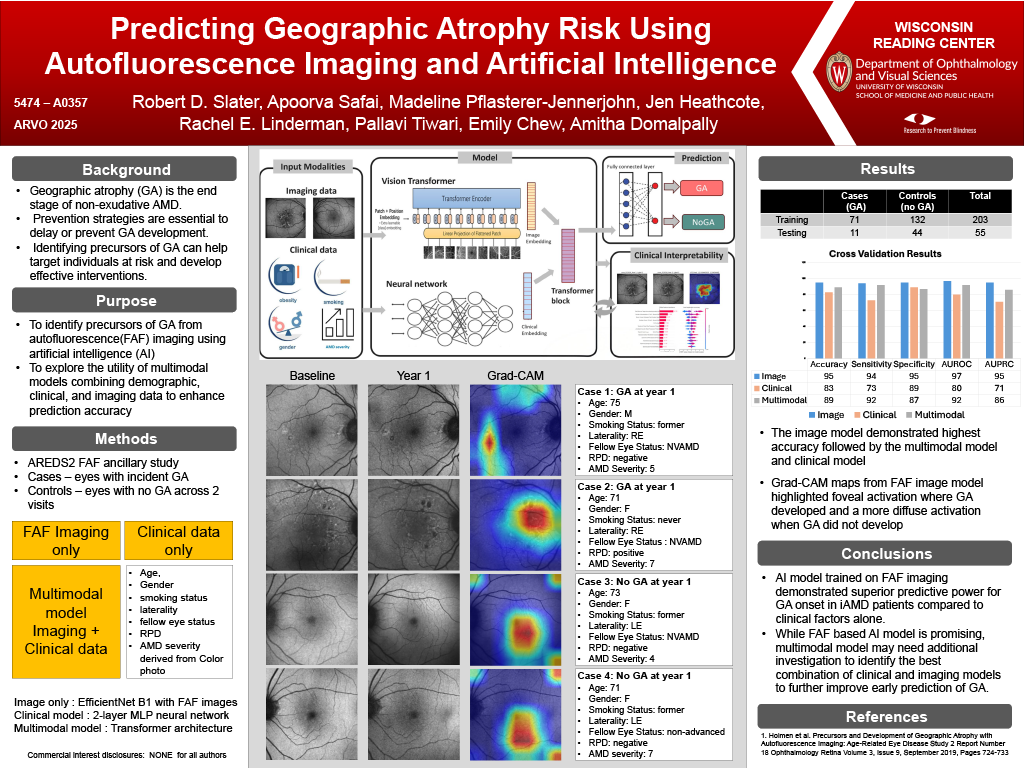
Purpose: Geographic atrophy (GA) is the end stage of non-exudative AMD. Prevention strategies are essential to delay or prevent GA development. Identifying precursors of GA can help target individuals at risk and develop effective interventions. The AREDS2 study followed patients with intermediate AMD to monitor GA development. As part of an ancillary study, fundus autofluorescence (FAF) images were obtained annually. This study aimed to identify precursors of GA from autofluorescence imaging using artificial intelligence (AI). This study also explores the utility of multimodal models combining demographic, clinical, and imaging data to enhance prediction accuracy.
Methods: FAF images of eyes without any GA and at least 2 consecutive annual visits were identified and divided into cases (developing GA at subsequent visit) and controls (no GA at subsequent visit). AI models were trained in a 5 fold cross validation frameworkusing data from 218 eyes (71 cases and 147 controls) Along with FAF images, additional clinical data were incorporated into a multimodal model, including age, gender, laterality, smoking status, fellow eye status, presence of reticular pseudodrusen (RPD), and AMD severity scores from color photographs. By combining demographic and clinical data with imaging features, a hybrid multimodal model was created. Model performance was compared between three approaches: clinical data alone, imaging alone, and clinical data combined with imaging.
Results: Model accuracy was highest for the multimodal model (accuracy: 78%, AUROC: 0.81), followed by the imaging-only model (accuracy: 75%, AUROC: 0.77), and then the clinical data-only model (accuracy: 75%, AUROC: 0.73). SHAP analysis of feature importance revealed that AMD severity scores and the presence of RPD were the most significant contributors to the clinical data model’s predictions.
Conclusions: AI models can effectively predict GA development and identify individuals at highest risk. Multimodal models improve prediction efficacy by integrating additional clinical data with imaging features. Further studies are needed to explore AI-driven feature discovery to better understand the etiology of GA and refine prediction strategies.