Rationale and Transition from Multistep Grading to Single Step Grading of Retinal Images at a Reading Center (2009)
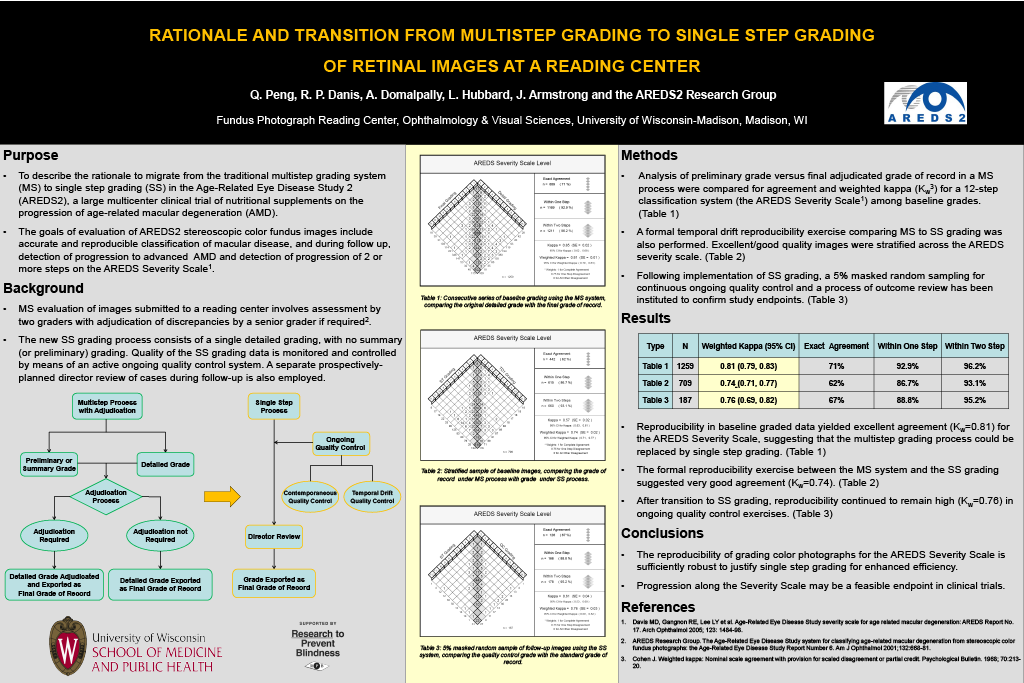 Qian Peng, Ronald P. Danis, Amitha Domalpally, Larry Hubbard, Jane Armstrong, and the AREDS2 Research Group
Abstract
Purpose: In the Age-Related Eye Disease Study 2 (AREDS2), a large multicenter clinical trial of nutritional supplements on the progression of age-related macular degeneration (AMD), we describe the rationale to migrate from the traditional multistep grading system (MS) to single step grading (SS)
Methods: MS evaluation of images submitted to a reading center involves assessment by two graders with adjudication of discrepancies by a senior grader if required. Analysis of preliminary grade versus final adjudicated grade of record in a MS process were compared for agreement and weighted kappa (wK) for a 12-step classification system (the AREDS Severity Scale) among baseline grades. A formal reproducibility exercise comparing MS to SS grading was also performed. Following implementation of SS grading, a 5% masked sampling for continuous ongoing quality control and a process of outcome review has been instituted to confirm study
endpoints was established.
Results: Reproducibility in baseline graded data yielded excellent agreement for the AREDS Severity Scale (wK¼0.83, n¼1261), suggesting that the multistep grading process could be replaced by single step grading. The formal reproducibility exercise between the MS system and the SS grading suggested very good agreement (wK¼0.74, n¼709). After transition to SS grading, reproducibility continued to remain high (wK¼0.88, n¼30) in ongoing quality control exercises.
Conclusions: The reproducibility of grading color photographs for the AREDS Severity Scale is sufficiently robust to justify single step grading for enhanced efficiency. Progression along the Severity Scale may be a feasible endpoint in clinical trials.