Calcified Drusen as a Baseline Risk Factor for Progression to Advanced Age-Related Macular Degeneration from the Age-Related Eye Disease Study (2006)
 Jane Armstrong, Ronald Danis, Matthew D. Davis , B. Zhang, L. –Y. Lee, Ronald Klein, Barbara E. Klein, Larry D. Hubbard
Abstract
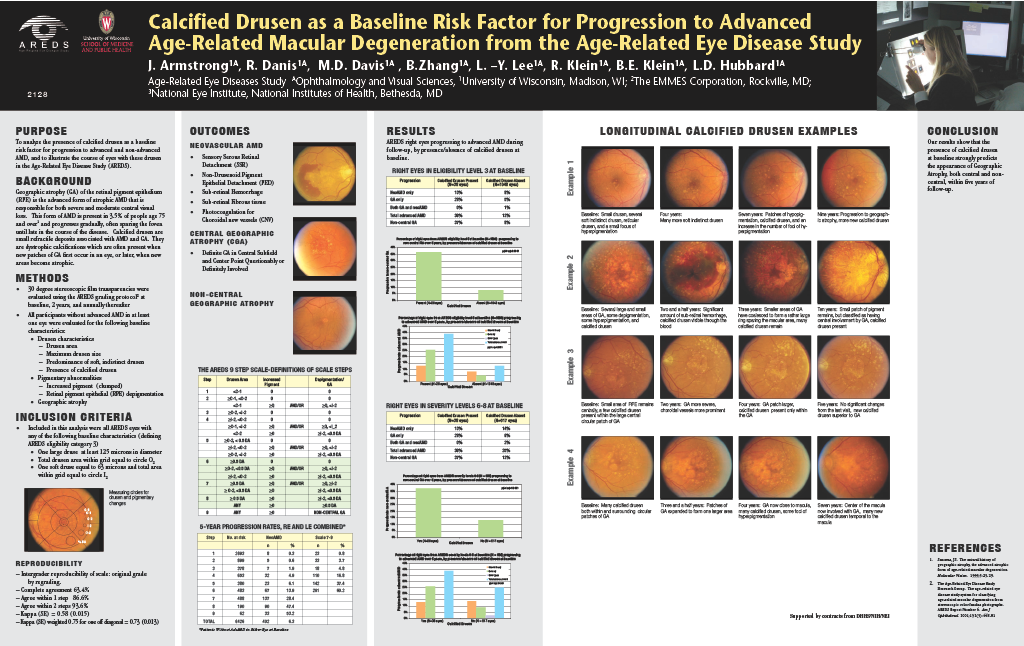
Purpose: To analyze the presence of calcified drusen as a baseline risk factor for progression to advanced AMD, and to illustrate the course of such eyes, in the Age-Related Eye Diseases Study (AREDS).
Methods: Calcified drusen are small refractile deposits associated with AMD, particularly geographic atrophy (GA). We compared 5-year rates of progression to advanced AMD (neovascular AMD and/or any geographic atrophy) in eyes with and without calcified drusen. We limited the analysis to eyes that at baseline (a) were in AREDS group 3 (having at least one large ordinary druse [>= 125μm] or extensive intermediate drusen), (b) did not already have non-central GA, and (c) had 5 years of follow-up. We used the extended AREDS severity scale to concentrate this analysis on eyes in levels 6-8 (characterized by large drusen area and/or marked pigment abnormalities less severe than GA).
Results: Among 2144 eyes in AREDS group 3, 75 eyes (4%) had calcified drusen and 2069 eyes (96%) did not. Progression rates to advanced AMD were 47% vs.14% respectively (p<0.0001 by chi-square). Dividing these progressions, neovascular AMD rates were 13% vs. 9%, central GA rates were 32% vs. 4%, non-central GA rates were 36% vs. 8%, and neo+GA rates were 1% vs. 1%, respectively. Restricted to the 1138 eyes in AREDS levels 6-8, 74 eyes (7%) had calcified drusen and 1064 eyes (93%) did not, with progression rates to advanced AMD of 82% and 37%, respectively, (p < 0.0001). Neovascular AMD rates were 14% vs. 14%, central GA rates were 31% vs. 8%, non-central GA rates were 37% vs. 13%, and neo+GA rates were 1% vs. 2%, respectively.
Conclusion: AREDS results show that presence of calcified drusen at baseline signifies increased risk for 5-year progression to advanced AMD – particularly GA, for which the risk is about 3-fold.