Reproducibilty of Classification by AREDS Severity Scale and Component Features in AREDS2 (2009)
 Ronald P. Danis, Jane Armstrong, Qian Peng, Amitha Domalpally, Larry Hubbard, and the AREDS2 Research Group
Abstract
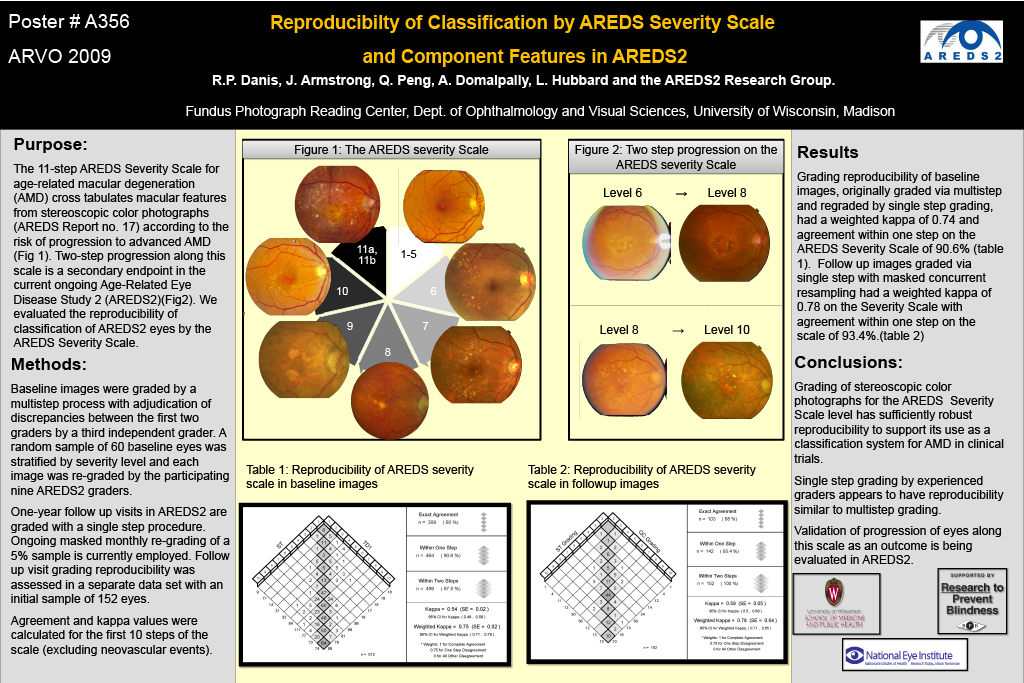
Purpose: The 11-step AREDS Severity Scale for age related macular degeneration (AMD) cross tabulates macular features from stereoscopic color photographs (AREDS Report no. 18) according to the risk of progression to advanced AMD. Two-step progression along this scale is a secondary endpoint in the current ongoing Age-Related Eye Disease Study 2 (AREDS2). We evaluated the reproducibility for classification of AREDS2 eyes by the AREDS Severity Scale.
Methods: Baseline images were graded by a multistep process with adjudication of discrepancies between the first two graders by a third independent grader. A random sample of 80 eyes was stratified by severity level and re-graded by 9 graders. Agreement and kappa values were calculated for the first 10 steps of the scale (excluding neovascular events). One-year follow up visits in AREDS2 are graded with a single step procedure; a method of ongoing masked regrading of a 5% sample is currently employed. Follow up visit grading reproducibility was assessed in a separate data set with an initial sample of 30 eyes.
Results: Baseline images regraded by single step grading had a weighted kappa of 0.74 and agreement within one step on the AREDS Severity Scale of 90.6%. Follow up images graded via single step with masked concurrent resampling had a weighted kappa of 0.88 on the Severity Scale with agreement within one step on the scale of 96.7%.
Conclusions: Grading of stereoscopic color photographs for AREDS Severity Scale level has sufficiently robust reproducibility to support its use as a classification system for AMD in clinical trials. Single step grading by experienced graders appears to have reproducibility similar to multistep grading. Validation of progression of eyes along this scale as an outcome is being evaluated in AREDS2.