Multimodal Capture of the 15-year Incidence of Intermediate or Late Age-related Macular Degeneration (AMD) and its Association with Macular Pigment Optical Density (MPOD) in the Carotenoids in Age-Related Eye Disease Study (CAREDS)
Zhe Liu, Amitha Domalpally, Amy E. Millen, Barbara A. Blodi, Thomas P. Lawler, Billy R. Hammond, Steven T. Bailey, Robert B. Wallace, Karen M. Gehrs, Ronald Gangnon, Lesley Tinker, Julie A. Mares
Abstract
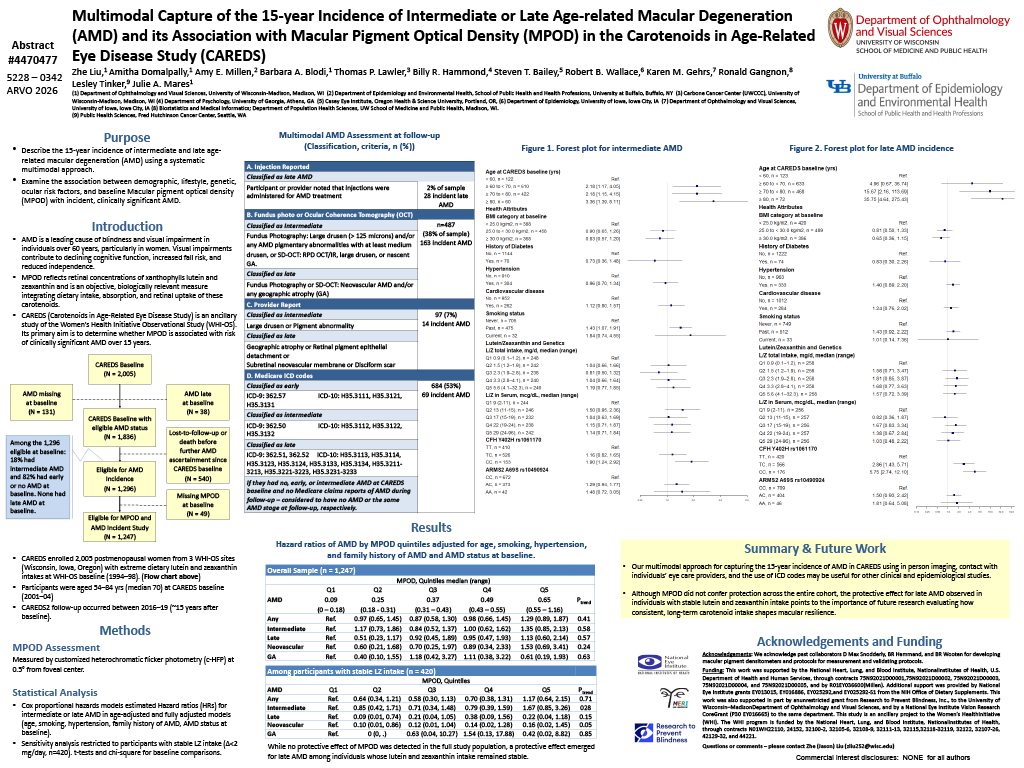
Purpose: Macular pigment, comprised of lutein (L) and zeaxanthin (Z), is hypothesized to reduce risk of AMD, but this association has not yet been studied in large longitudinal observational studies. Using data from CAREDS, we examined associations between MPOD and the incidence of AMD over approximately 15 years of follow-up.
Methods: This analysis includes 1,247 postmenopausal women (54-85 years) with MPOD measures at CAREDS baseline (2001-2004) from heterochromatic flicker photometry and AMD incidence determined between CAREDS baseline and 15-year follow-up (2016-2019). CAREDS participants were excluded if they with missing AMD or MPOD measures at baseline, had late AMD at baseline, or were lost to follow-up/death before further AMD ascertainment. AMD severity was classified according to Beckman scale (1 = no AMD, 2 = normal aging change, 3 = early AMD, 4 = Intermediate AMD, and 5 = late AMD) using a multimodal capture method. Incident intermediate AMD was defined as movement from the first three severity levels to the fourth. Incident late AMD was defined as progression from the first four levels to the fifth. Hazard Ratios (HR) and 95% confidence intervals (CIs) for developing incident intermediate or late AMD (any AMD) were estimated with Cox-proportional models. In exploratory analyses we reran our models restricted to a subset of participants (n=420) who maintained stable dietary and supplemental L and Z intake over follow-up (change <2 mg/day).
Results: Of 1,247 participants, 183 developed incident intermediate AMD and 78 developed incident late AMD (48 neo-vascular AMD and 30 geographic atrophy). HR (95% CIs) for any, intermediate, or late AMD in quintile (Q)5 versus Q1 of MPOD were 1.28 (0.89, 1.85), 1.25 (0.79, 1.97), and 1.38 (0.73, 2.59), respectively. When analyses were restricted to those with stable L and Z intake, results were consistent for any or intermediate AMD, but higher MPOD was associated with reduced risk of incident late AMD (MPOD Q2-5 versus Q1, HR (95% CI) = 0.29 (0.10, 0.84), p-value 0.02).
Conclusions: There was no association between MPOD and any incident AMD over 15 years of follow-up in the CAREDS cohort. Among the subset of participants with stable L and Z intake, MPOD was associated with reduced risk of incident late AMD.