Deep Learning-Based Quantification of GA Area on OCT Scans
 Rushi N. Mankad, Madeline Pflasterer-Jennerjohn, Rachel E. Linderman, Robert Slater, Amitha Domalpally
Abstract
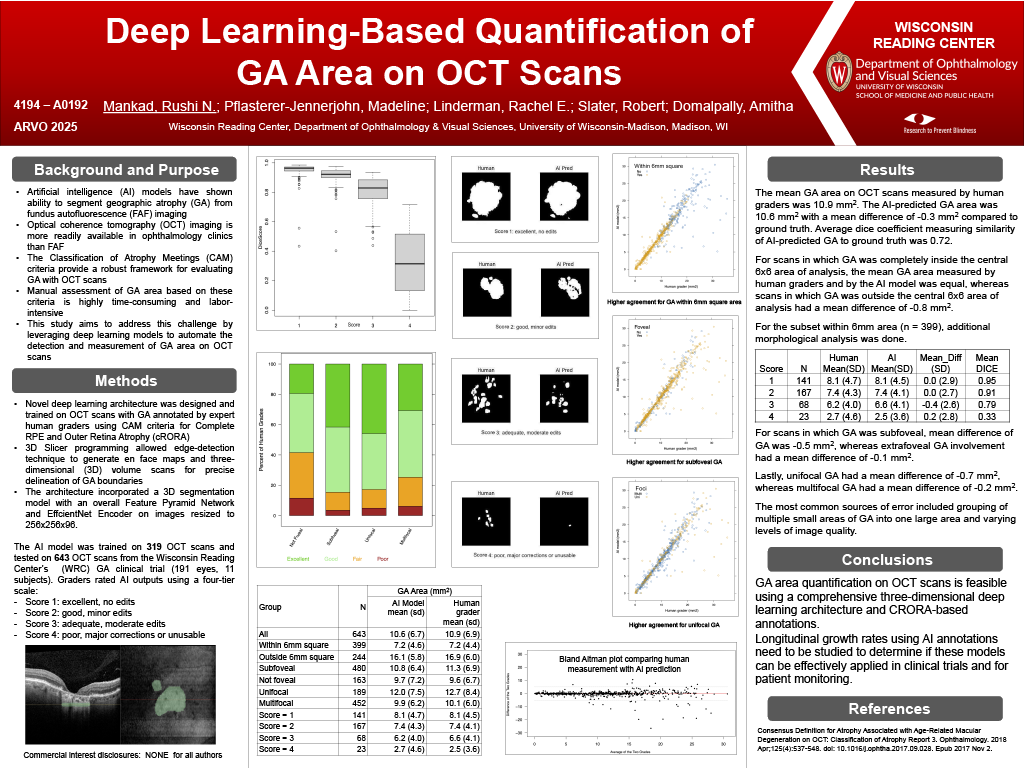
Purpose: The consensus of Atrophy (CAM) criteria provides a robust framework for evaluating geographic atrophy (GA) with optical coherence tomography (OCT) scans. However, the manual assessment of GA area based on these criteria is highly time-consuming and labor-intensive. This study aims to address this challenge by leveraging deep learning models to automate the detection and measurement of GA area on OCT scans.
Methods: A novel deep learning architecture was designed and trained on GA OCT scans annotated by experienced readers using the Complete RPE and Outer Retina Atrophy (CRORA) criteria. Annotation involved edge detection techniques to generate en face maps and 3D volume scans for precise delineation of GA boundaries. The training dataset included 296 scans, with internal validation performed on 99 scans. The architecture incorporated a 3D segmentation model with an overall Feature Pyramid Network and EffcientNet Encoder on images resized to 256x256x96.
Results: The mean GA area on OCT scans measured by ground truth annotations was 8.31 mm2. The AI-predicted GA area was 8.62 mm2 with a mean difference of -0.31 mm2 compared to ground truth. Average dice coefficient measuring similarity of AI-predicted GA to ground truth was 0.79. The most common sources of error included grouping of multiple small areas of GA into one large area and varying levels of image quality.
Conclusions: GA area quantification on OCT scans is feasible using a comprehensive three-dimensional deep learning architecture and CRORA-based annotations. Longitudinal growth rates using AI annotations need to be studied to determine if these models can be effectively applied in clinical trials and for patient monitoring.