Index of Non Circularity as a Predictor for Progression in Eyes with Geographic Atrophy (GA) (2013)
 Ronald P. Danis, Amitha Domalpally, Ellie Corkery, Ruth Shaw, Ashwini Narkar, Jim White
Abstract
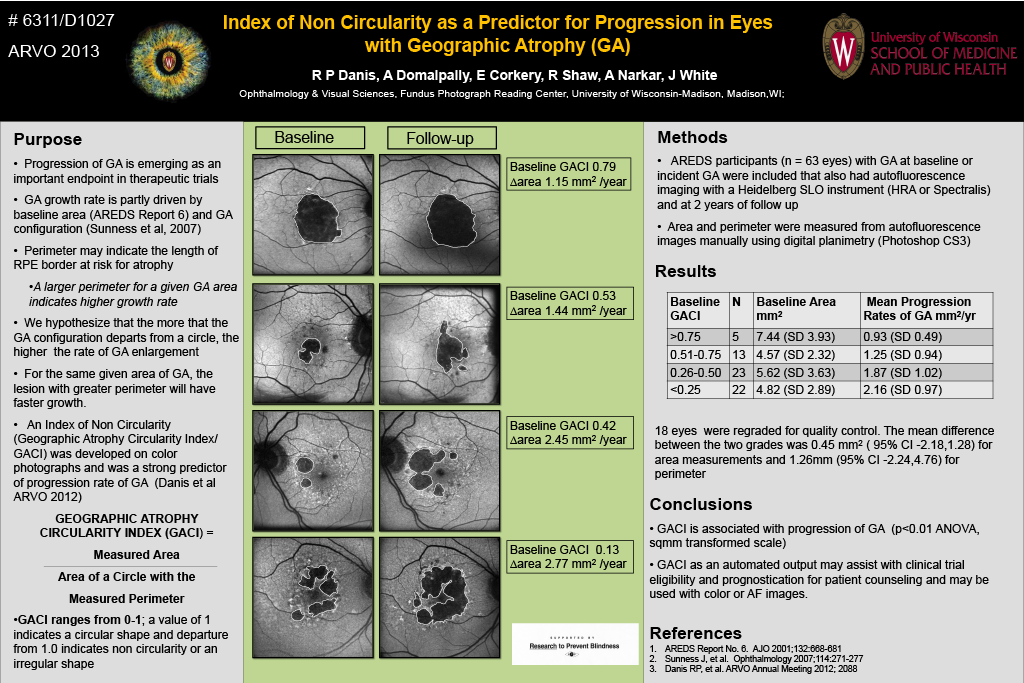
Purpose: Given that baseline area and configuration of GA are associated with its progression rate, we hypothesized that a non circular configuration has a higher growth rate. Index of non circularity was developed on color photographs and was a strong predictor of progression rate of GA. The purpose of this study is to evaluate the index in a sample of autofluorescence images submitted for the Age Related Eye Disease Study 2 (AREDS2).
Methods: Among 63 eyes with GA that had incident or baseline GA with 2 years of follow up, the perimeter and area of GA was measured from autofluorescence images( Heidelberg) using planimetry. A Non-Circularity Index (NCI) was calculated based upon the ratio of the measured area of GA (actual area) to the area of GA expected for a given perimeter (expected area) NCI = actual area/expected area; range 0.0 to 1.0; a value of 1.0 indicates a circular shape and departure from 1.0 indicates non circularity or an irregular shape. The relationship between progression rates of GA area and NCI were analyzed in this pilot sample.
Results: The mean area of GA at baseline was 5.27 mm2 (+/- 0.81 95% CI). Baseline NCI was categorized as 0-0.25 (n=22), 0.26-0.50 (n= 23), 0.51-0.75 (n=13), and 0.76-1.0 (n=5). The mean progression rates of GA for these NCI categories were 2.16, 1.87, 1.25, and 0.93 mm2/yr respectively (p<0.01ANOVA).
Conclusions: In this pilot sample, NCI is moderately associated with progression rate of GA. Using semi automated software for GA segmentation, availability of NCI as an automated output can assist with clinical trial eligibility.