Comparison of Film and Digital Fundus Photographs in Assessing Diabetic Retinopathy (2010)
 Sapna Gangaputra, Ronald Danis, and Talat Almukhtar for the Diabetic Retinopathy Clinical Research Network. Department of Ophthalmology, University of Wisconsin, Madison, WI. Jaeb Center for Health Research, Tampa, FL.
Abstract
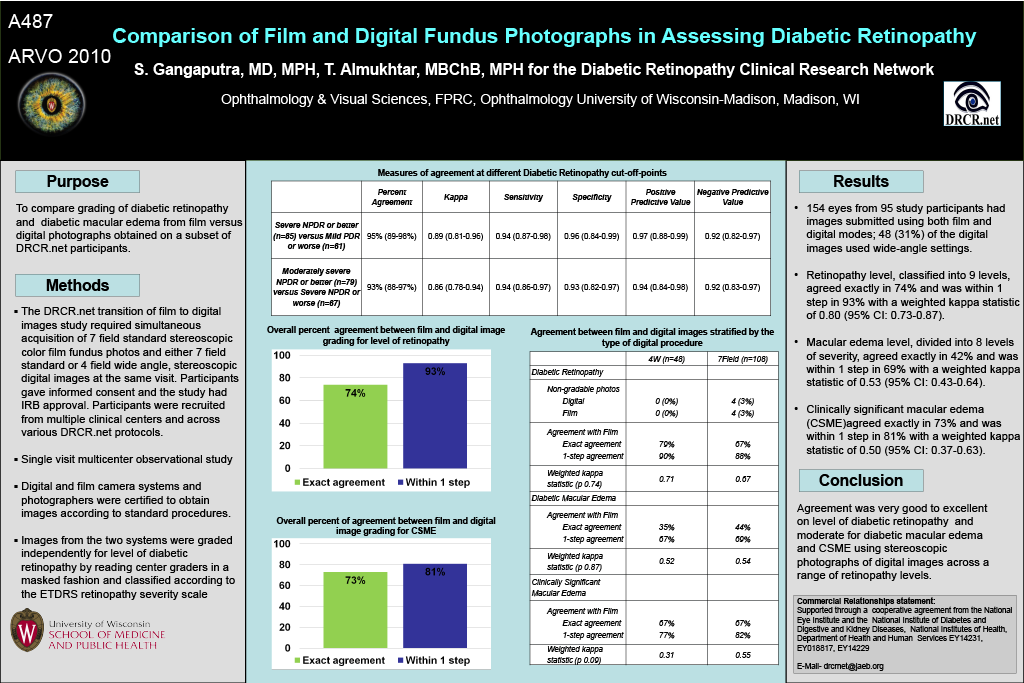
Purpose: To compare grading of diabetic retinopathy of film versus digital images from a subset of Diabetic Retinopathy Clinical Research Network (DRCR.net) clinical centers.
Methods: The DRCRnet film to digital protocol, included simultaneous acquisition of 7 field standard color film fundus photographs and digital images, either 7 field standard or 4 field wide angle. The study was performed with patient informed consent and under approval of the institutional review boards. Patients were recruited from multiple clinical centers and across various DRCRnet protocols. Digital camera systems and photographers at DRCR.net sites were certified to obtain digital images according to standard procedures. The images were graded for level of diabetic retinopathy by experienced reading center graders in a masked fashion and classified according to ETDRS retinopathy severity scale.
Results: 153 eyes from 95 study participants had images submitted using both film and digital modes; 48 (29%) of the digital images used wide-angle settings. The retinopathy level on film and digital images, respectively, included 39 (23%) and 35 (21%) eyes no worse than moderate non-proliferative diabetic retinopathy (NPDR), 55 (33%) and 51 (30%) eyes, with moderately severe or severe NPDR, 70 (42%) and 73 (44%) eyes with mild PDR or worse, and could not be graded in 4(2%) and 9 (5%) eyes. Retinopathy level agreed exactly in 74% and was within 1 step in 93% with a weighted kappa statistic of 0.80 (95% CI: 0.73-0.86). Sensitivity and specificity of digital versus film mode for detecting severe NPDR or better was 96% (95%CI: 84%-99%), and 92% (95%CI: 85%-96%) respectively.
Conclusions: Agreement was very good on level of diabetic retinopathy graded using stereoscopic photographs of digital images as compared with film images across a range of levels of retinopathy among many sites participating in the DRCR Network. Advantages of digital photography are the ability to review images immediately, so photographers can retake images if required. Ease of web based transmission and virtual storage are added benefits.